

During the 16th Travel Journalism Congress held in Monterrey, the Top Five 2025 of the WTJO Index was presented

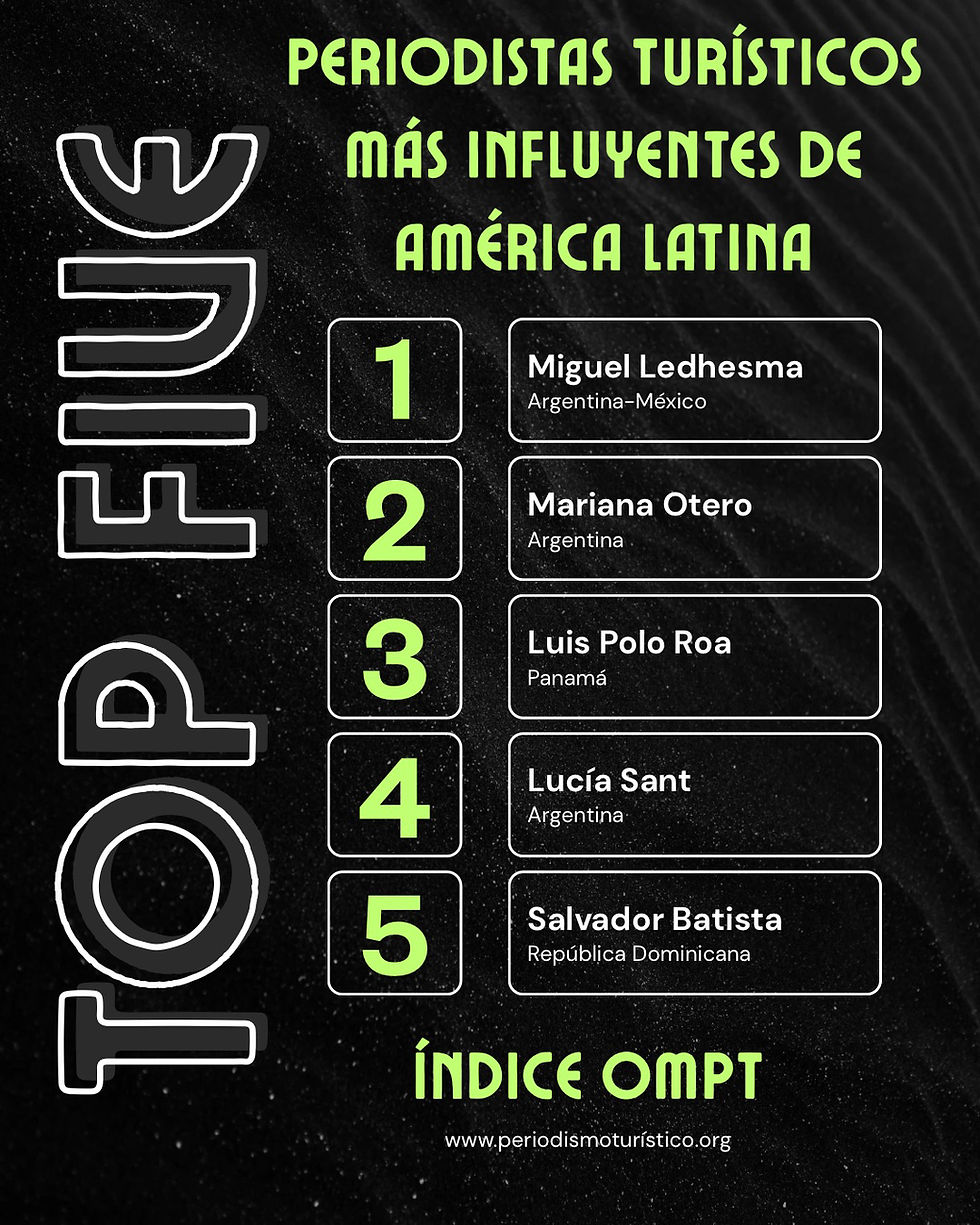
On April 27, 2026, within the framework of the 16th Travel Journalism Congress held in Monterrey at the Autonomous University of Nuevo León, the five journalists who make up the Top Five 2025 of the WTJO Index of the Most Influential Travel Journalists in Latin America were announced.
First place went to Miguel Ledhesma, an Argentine based in Mexico, who achieved a score of 86. He was followed by Mariana Otero from Argentina with 79 points, Luis Polo Roa from Panama with 77, Lucía Sant from Argentina with 76, and Salvador Batista from the Dominican Republic with 74.
The announcement was made before the academic community, tourism professionals, and specialized journalists who participated in the congress, consolidating the WTJO Index as a growing reference in the evaluation of travel journalism in the region.
The WTJO Index of the Most Influential Travel Journalists in Latin America is an evaluation system designed to measure the quality, impact, and responsibility of journalistic work in tourism. Its purpose is to identify those who not only have visibility but also generate real transformation in the way tourism is understood, communicated, and experienced.
Unlike traditional rankings focused on popularity, this index proposes a different approach, prioritizing the structural value of journalistic work over media exposure. To achieve this, it incorporates criteria related to ethics, content quality, and cultural contribution, making it a useful tool for journalists, institutions, researchers, and platforms seeking reliable references.
One of the pillars of the WTJO Index is its central idea: to redefine influence in travel journalism by separating visibility from the real capacity to generate impact. In this sense, it distinguishes between visibility capital, associated with reach and media exposure, and influence capital, linked to the ability to generate concrete changes, transform narratives, or contribute meaningful knowledge.
Under this logic, the index seeks to avoid biases inherent to digital algorithms and emphasizes that not all visibility implies relevant impact. As a synthesis of this approach, one of its key phrases stands out: visibility shows who is seen; influence shows who transforms.
To be part of the index, journalists must meet a series of requirements that ensure coherence and quality in the evaluation. These include active membership in the WTJO, ongoing production of travel-related content in different formats, adherence to ethical standards, continuous updating, submission of verifiable evidence, and a clear focus on travel journalism. Additionally, promotional content that lacks journalistic treatment is excluded.
The measurement is carried out through a 100-point scale that considers various dimensions of professional work. Aspects such as content quality, real impact, reach, credibility, innovation, sustainability, career trajectory, professional influence, and regional contribution are evaluated.
In this way, the WTJO Index is consolidated as a tool that does not measure who speaks the most, but who provides the greatest value to tourism, promoting higher standards and a deeper perspective on the role of journalism in shaping the tourism sector in Latin America.


Comentarios